Sunday, December 11, 2011

Balky Winter

A Facebook friend from Laramie posted today that she was going cross-country skiing today at the Happy Jack recreation area just east of town. I'd spent a fair amount of time there during Laramie winters, first learning to ski, then gliding over the well-packed trails, sometime with Kerry, usually alone.

When we moved to northern Idaho, we took up snowshoeing for winter activity. We've been looking forward to some time on the logging trails that cross our 66 acres, especially since some good friends have just decided to get some gear and try snowshoeing this year. But there's been no snow. Just a hard frost every night, coating the cars, the fields, the road, and the trees. some areas are so shaded from sun that the first frost is still on the ground.

The cats don't seem to mind. They're still hunting mice, crouched perfectly still on the cold, white grass, concentrating on the catch, more successfully than not. And the neighbor's chickens don't seem to care. The neighbors went away for the day and asked me to put the birds to bed at night and let them out of their roosting box in the morning. The rooster let me know in no uncertain crows that he'd expected to be let out earlier than I did (well, it did take me 15 minutes to defrost the car this morning). The rooster and his six-hen harem were out of their heated box and wired run as soon as I opened them. I think I'd rather have stayed in the box a while longer.

It's been overcast much of the week, with a weather inversion that's engendered a ban on outdoor burning. So, I've been spending time on our second hill felling trees Kerry marked earlier in the year, and cutting them up for firewood. Now the hill is littered with branches that I need to haul to the several burn piles we've built. But, who knows when the ban comes off. I check The Weather Channel Web site daily, looking for sunny days when I can get back on my road bike (armed with warmer cycling gloves) and when I'll need to mount the snow blade on my ATV. Expecting one sunny day this week; no appreciable snow.

Winter remains balky.


Friday, December 9, 2011

Past Times Books: Historical Fiction E-Books


Back in October I was flattered to be asked by Wendy Bertsch, the founder of the website Past Times Books, to join its cadre of historical fiction authors and list my historical novels, The Wolf's Sun and A Devil Singing Small  It's a very particular website and vets applicants' novels for writing quality and, I assume, the ability to tell a good story.

The authors who reside on the site are nice, too, and have led interesting lives, which they write about. Best of all, you can peruse their works of historical fiction, which have direct links to Kindle and other ebook sites for purchase.
I read Dodging Shells, by Bertsch, a novelization of her father's World War II military experience as a Canadian soldier during the invasion of Sicily and the push up the boot of Italy.  It was poignant (he was so young) and it was humorous (if you can't find humor in war, you'll go mad).  Not a lot has been written about the Canadian forces during World War II, but they fought alongside the British from the beginning of the war in 1939.

I feel quite at home on Past Times Books, as though I've become a member of an exclusive club.  If you're in search of some good historical fiction, I hope you take a look at this website and the literary riches it displays.

Saturday, November 19, 2011

Early Winter


Winter has come to the Inland Empire. About two inches of snow on the ground, bearing the tracks of turkey and deer from the house to the mailbox. They've come down from the hills, scrounging for food. This morning six does and yearlings were milling about under the willow trees in the front yard, eating leaves that had blown down during the week and digging through the snow for still green grass. I threw them some apples that had gone bad in our cold room; a few of the shyer deer, skittered away when I opened the door, but the bolder ones went right for the apples, some of which were purloined from under their black, wet noses by large turkey hens. Later, when I walked a couple of letters to the mailbox, about 20 turkeys were gathered across the partially frozen creek, and another 40 were huddled along our north fence line.

The forecast is for rain and snow most of the next 10 days, but no prediction of accumulation. So, I'm holding off on fixing the plow blade to my ATV, thinking I'll get to do some more work on the hills - cutting wood and building up our burn piles - before the serious weather hits.

Hunters are out in force; the gunshots sporadically echoing in the valley throughout the day. Last week a deer hunter knocked on our door, saying he'd hit a turkey on the county road with his truck, asking if he could remove it from our property. I told him he could. Kerry later said that he went through the wire fence along the county road and didn't reattach it to the gate. I'll take care of that when the weather warms a bit next week. We think he might have left a pile of turkey residue, including it's final bowel movement. Pete, our black, long-haired cat, showed up later that day with his head-fur full of turkey crap. Had he rolled in the remains? Kerry cleaned him up with a handful of baby wipes, and now he's back to his usual handsome - though crabby - self. Another hunter knocked at the door a day later and asked if he could shoot "one of your deer." We declined. During the years, we have come to think of them as our deer, and they're not for hunting.

Piles of firewood have been building up in the back meadow: mixed pine and fir, aspen, and apple. We've advertised it in the local free ad paper, and have sold a cord of the softwood. People have become really particular about their wood - they need the rounds split; the logs are too long for the wood stove; they really want just red fir; the apple wood is too old and holey. Maybe the wait-till-the-last-minute crowd won't be a picky as winter closes further in.

So, with snow on the ground, there's less time working in the hills. Watching a lot of football (great game between Oklahoma State and Iowa State yesterday) and waiting for my Kindle Fire to arrive, so I can catch up on free e-books I've downloaded to my computer. Amazon.com shipped it Nov. 14, and it's been on the milk train since: Phoenix, Los Angeles, Kent, Washington. Funny thing is, the Kindle comes with a two-month Amazon Prime try-out. One of the benefits of Prime is two-day shipping on everything - except, it seems, the Amazon Kindle Fire.

Sunday, November 6, 2011

HERITAGE (HEIRLOOM) APPLES

  This morning I listened to a story on NPR about people looking for abandoned heritage apple trees in the Salmon River area of Idaho. It was titled  “Pioneer Apples, Saving A Taste of Idaho’s Past.”  http://www.nwfoodnews.com/2011/10/28/seeking-genetic-diversity-in-abandoned-apple-orchards/
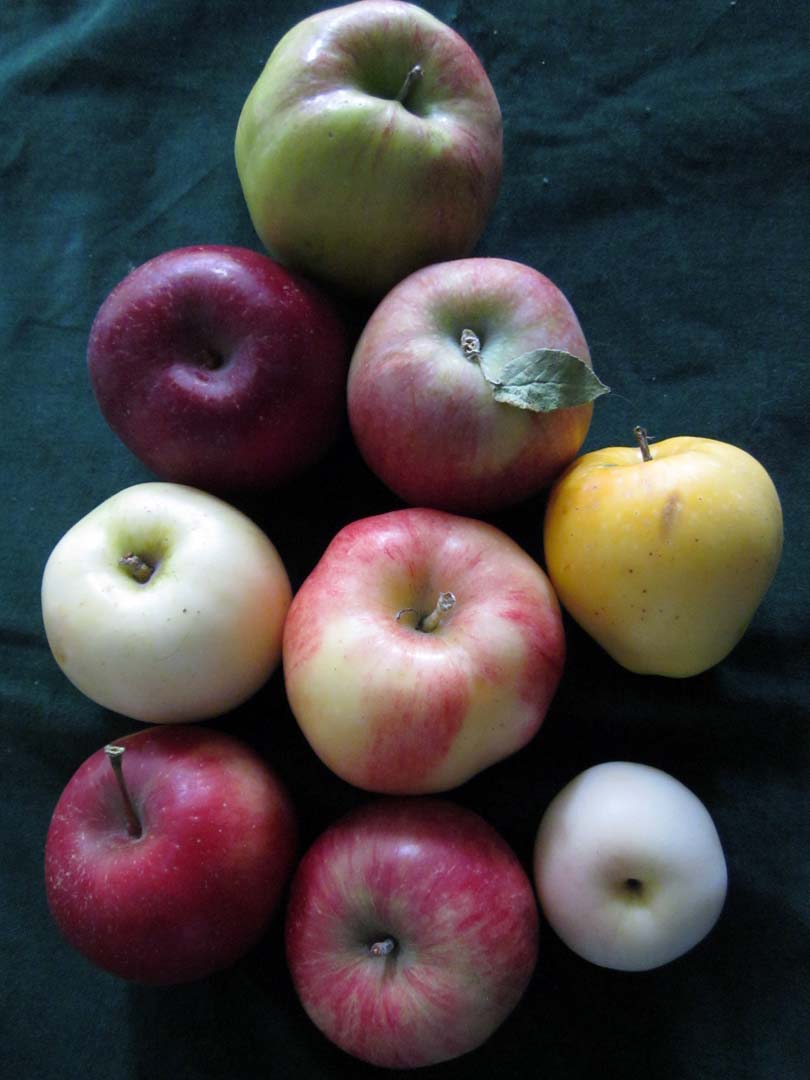
                Up here in the Panhandle there are more than 100 heritage apple trees of various ages on our 66 acres. I know that because I mapped them a couple of years ago, following deer trails through the woods, and coming across another apple tree among the pines.  There are only four original trees in the old orchard by the spring that old Mr. Cable planted in the 1930s or earlier.  The rest have been unconsciously planted by the deer.  I recall the names Mom mentioned during my childhood in the 1950s – McIntosh, Winesap, old Delicious, Jonathan, Wagener, Baldwin, Rome Beauty, Russet – but I am unable to marry most of the apples to the names. (See the photo to right of seven to nine different varieties.)  There are even hidden trees producing apples I know we didn’t have during my childhood. 
                One mystery apple’s name has been solved.  There are about five trees that produce a wonderful eating apple scattered near Anna Spring and on a western slope among the pines, but I have no memory of a similar one from my youth.  Our neighbor, Pat Ferry, is the grandson of the first couple who homesteaded across our narrow valley in the 1890s.  He had mentioned Grandma Ferry’s apple tree as a Winter Banana, and that he had loved the fruit as a boy. The family story was that his grandfather brought it from Ireland.  Sadly, the old tree died a few years ago.  When Pat paid us a visit last week, I brought out some ribbed apples bearing a bright pale yellow background and a contrasting blush, darkening to dark pinkish red.  “Is this your Winter Banana?” I asked.  “Yup, that’s what that is,” he replied, and we enjoyed the crisp, juicy, mild sub-acid flesh while we visited.  Our apples probably aren’t as large as Grandma’s Ferry’s had been, because the trees are not irrigated, and must seek their own moisture. But they’re just as good, I bet.  But it didn’t come from Ireland; the Winter Banana actually originated in Indiana in the early 1890s.
                I know which is the old Delicious because of the little knobs on the bottoms of the fruit.  It is nothing like the Red Delicious in the grocery stores, which keeps their cheery red skin intact even when the flavor has disappeared from inside.  Our old Delicious has a bit of a bite, but still is an eating apple.  I didn’t appreciate it as a child; Mom would put one in my lunch pail, and I’d trade it for someone’s banana.
                The Jonathan is described as having a brilliant red color, being highly flavored, and useful as a dessert or cooking apple. It was sold for the fancy trade during the holiday season. So, now, I know that one. 
                There are two books on http://books.google.com/ebooks that can be downloaded free to help identify heirloom or heritage apples.  One is the Manual of Horticulture 1913, Idaho State Board of Horticulture, which has plates of some of the apples known to be best for the Idaho climate.  The other - which will make your head spin because of the many color plates (not to mention the half-tone plates) of nearly every apple developed, plus its description and history - is The Apples of New York, published in 1905.  One would think it easy to identify our two varieties of white or transparent apples (one small and round and the other larger and more oval).  But, no, there are just too many that were developed in the early days.  They are both sweet, but with a different tang.  Is the larger one a White Pearmain and the smaller a White Pippin (related to the Michael Henry Pippin)?  Perhaps I’ll never know.


                And which ones did Mom use to make those wonderful apples pies?

Saturday, September 17, 2011

Independents' Day

I was thrilled to get a great review for The Wolf's Sun from a historical novel reviewer, Siobian Minish of The Owl Bookmark Blog  Four and one-half owls out of five.  She also requested an Interview, the result of which is also on her blog. 

We indie authors are no different from small press authors - we must do our own publicity and market our books ourselves. The only difference is that we don't worry about our books going out of print or sharing our income with an agent and publisher. We share with only Amazon and Barnes & Noble (and that's fair).

The Kindle (electronic) and Create Space (for paperbacks) phenomenon is what indie authors have been waiting for longer than we realized. It's as nice as being able to download movies directly to one's television.  Edgar Allen Poe and Walt Whitman, among so many authors who self-published, would be so envious.  Some authors, such as the Pinkerton detective Charles Siringo, went broke trying to get out their stories. Not anymore.
    Oh, yes, The Wolf's Sun will soon be out in paperback, available from Amazon.com.

Monday, September 12, 2011

Oh, Them Eggs...


...they remind me of a chicken and I'd rather have a chicken than eggs. (Martin Mull)

Our neighbors have both, and when they went off for the weekend, they asked us to make sure the door to the chickens' temporary home was partially opened in the morning and closed at night - and, we got to keep any eggs the hens laid overnight. Easy to do.


While their roosting box is being finished, the chickens are living in a large shed, with a 2" x 4" roost, some hay bales on which to lay, and a concrete floor where a couple of eggs (and a lot of chicken droppings) ended up. But there on the hay, on the second night of our chicken sitting, were three eggs: one large and light blue; one small and light brown; one larger and a darker brown, with speckles.

When the neighbor lady came by to thank us (with a yummy loaf of bread and a delicious salami), we asked which hens produced which eggs. The blue egg was the product of an Ancona hen; the light-brown egg was laid by a New Hampshire Red; and the larger brown, speckled, egg is from a Black Sex Link hen (no, we'd never heard of them either). The Guinea hens came up empty.

The New Hampshire egg had a double yoke, but the three weren't enough for an omelet. So, I added a couple of grocery store chicken eggs to the mix. But, before I did, I had a chance to examine the different colors of the egg yolks. The New Hampshire double yolk was a dark yellow; the Black Sex was a bit lighter; the Ancona was even lighter; but the store-bought eggs were starkly brighter yellow, with a thinner consistency, and their shells were markedly thinner than the neighbors' eggs.

Too late, I realized I should not have scrambled them for an omelet (with cheddar, home-grown tomatoes, and home-picked morels). I should have fried them individually for a taste-off. But, I've been assured there are more local eggs in our future. A man can learn from his mistakes.

Saturday, September 10, 2011

Old Friends and New


There's a common belief - I'm not ready to call it common wisdom - that men don't make friends after the age of 30. I met Steve when I was 36, interviewing for a job with the Public Affairs Office of the U.S. Naval Academy. He was the public affairs officer, a lieutenant commander and graduate of the academy; I was a bearded refugee from the Department of Health and Human Services, with 10 years experience working for the Army. It was an interesting interview, including a Myers Briggs Test (not allowed under federal human resources rules) and a lot of time with the office secretary, who apparently liked me.

I only worked with Steve for a year; the Navy promoted him to captain and rotated him early to the 7th Fleet. During the intervening years, through his reassignments and my job changes, Karen and I remained friends with Steve and his wife. They stayed at our house on the way to Pearl Harbor, and on the way back. They'd visit us in Laramie, Wyoming, whenever they visited Steve's brother in Ft. Collins, Colorado. Steve came by himself after he and his wife divorced, and with his brother and their sons on their way to Jackson Hole.

A few years ago, Steve met Karen and me in Portland for a wine-tasting tour of Oregon's Willamette Valley. We learned a lot about wine from him, but it was more of a good way for us to spend a few days together.

Steve was one of the first friends to contact me when I went through cancer surgery. And he called on his way to Indiana to bury his mother. We talked through his troubles with his then girlfriend and celebrated by phone his thriving new business and catamaran. Eventually, we became aware of his new girlfriend, Luz Marina, whose name translates as Light of the Sea, a fitting companion for a mariner. We knew she was Colombian, but not much beyond that. Then, in the spring, Steve said they wanted to come visit us in Idaho. We enthusiastically welcomed them, though with some trepidation. Would we like her? Would she like us?

The pending visit gave us the impetus to do some work on the old house Karen's father had built in the early-mid 1950s - painting the house and garage; hanging a new light in the living room. We also laid in a modest supply of local wines and worked on interesting menus.

Karen and I loitered in the arrivals area of Spokane Airport, waiting for the plane to debark. The arrivals board showed the plane had arrived on time. A Chinese family reunited; a foreign exchange student smiled at a couple holding his name on a placard. Then, there they were. Steve had aged, as had we, bearing the signs of too much work and a broken neck suffered the year before; Luzma was tall and slim, with long dark hair and eyes so dark they seemed to be all pupil. Hugs all around and back to our house, catching up with Steve, learning about Luzma.

What a wonderful visit. We had breakfasts in and lunches out. I cooked standard American fare for dinner; Luzma made a delicious dish from Spain. We drank good beer (Red Hook ESB) and better wine Steve bought on a visit to Arbor Crest Winery. We took long walks on our land and had long talks by the creek. We visited Coeur d'Alene; I took Steve for a ride to the top of our property on my ATV; we picked blueberries at our neighbor's patch; Steve and Luzma taught us a card game, which we enjoyed with a neighboring couple.

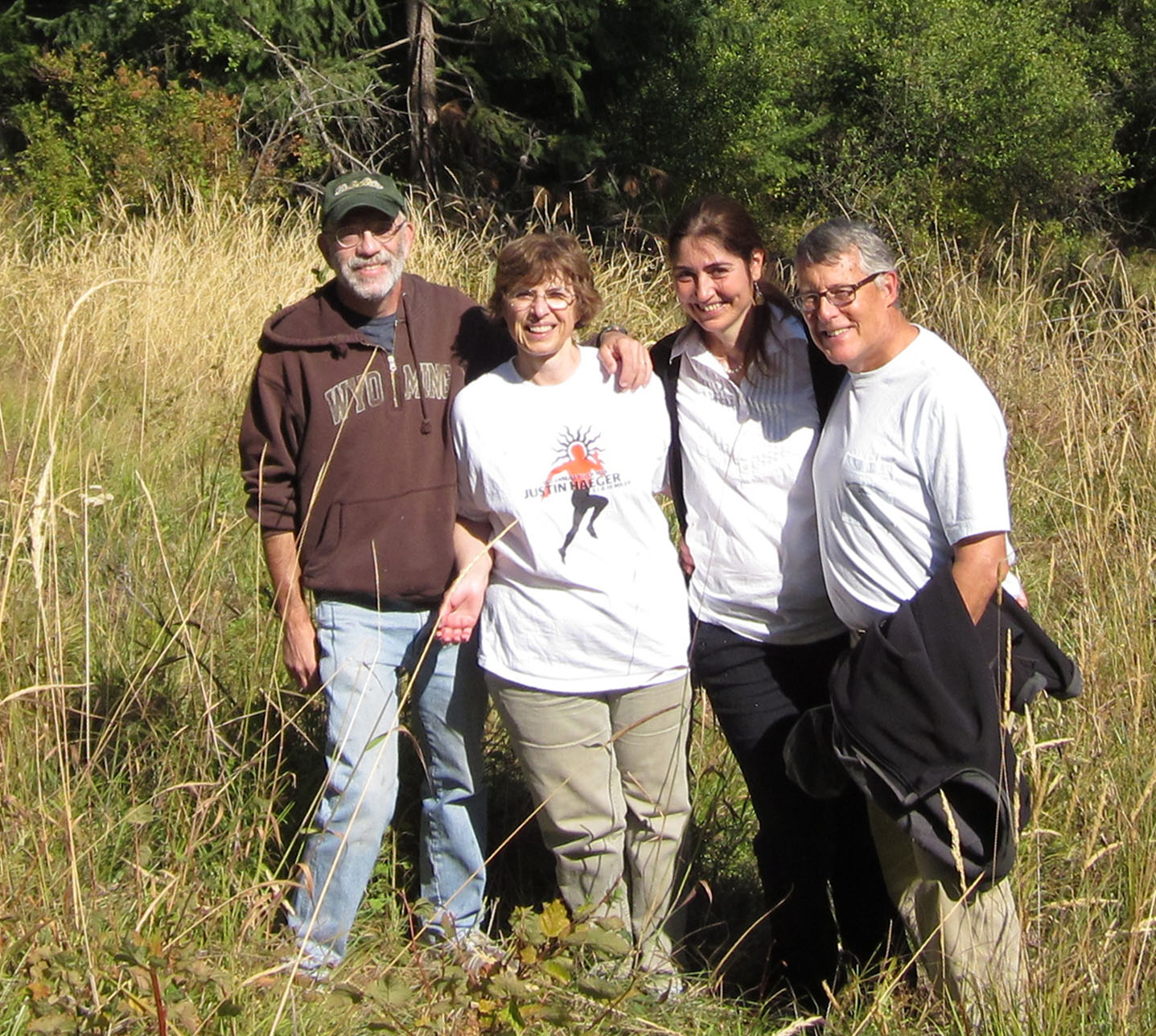
Our friendship with Steve didn't miss a beat; and we felt we'd known Luzma for years rather than days. Old friends and new - three of us now in our 60s, one in her 50s. Soon, perhaps, a visit to Steve and Luzma in Virginia, or a week in Vancouver, or even a trip to Spain (at least one of us can speak Spanish - and it's not me).