Saturday, September 17, 2011

Independents' Day

I was thrilled to get a great review for The Wolf's Sun from a historical novel reviewer, Siobian Minish of The Owl Bookmark Blog  Four and one-half owls out of five.  She also requested an Interview, the result of which is also on her blog. 

We indie authors are no different from small press authors - we must do our own publicity and market our books ourselves. The only difference is that we don't worry about our books going out of print or sharing our income with an agent and publisher. We share with only Amazon and Barnes & Noble (and that's fair).

The Kindle (electronic) and Create Space (for paperbacks) phenomenon is what indie authors have been waiting for longer than we realized. It's as nice as being able to download movies directly to one's television.  Edgar Allen Poe and Walt Whitman, among so many authors who self-published, would be so envious.  Some authors, such as the Pinkerton detective Charles Siringo, went broke trying to get out their stories. Not anymore.
    Oh, yes, The Wolf's Sun will soon be out in paperback, available from Amazon.com.

Monday, September 12, 2011

Oh, Them Eggs...


...they remind me of a chicken and I'd rather have a chicken than eggs. (Martin Mull)

Our neighbors have both, and when they went off for the weekend, they asked us to make sure the door to the chickens' temporary home was partially opened in the morning and closed at night - and, we got to keep any eggs the hens laid overnight. Easy to do.


While their roosting box is being finished, the chickens are living in a large shed, with a 2" x 4" roost, some hay bales on which to lay, and a concrete floor where a couple of eggs (and a lot of chicken droppings) ended up. But there on the hay, on the second night of our chicken sitting, were three eggs: one large and light blue; one small and light brown; one larger and a darker brown, with speckles.

When the neighbor lady came by to thank us (with a yummy loaf of bread and a delicious salami), we asked which hens produced which eggs. The blue egg was the product of an Ancona hen; the light-brown egg was laid by a New Hampshire Red; and the larger brown, speckled, egg is from a Black Sex Link hen (no, we'd never heard of them either). The Guinea hens came up empty.

The New Hampshire egg had a double yoke, but the three weren't enough for an omelet. So, I added a couple of grocery store chicken eggs to the mix. But, before I did, I had a chance to examine the different colors of the egg yolks. The New Hampshire double yolk was a dark yellow; the Black Sex was a bit lighter; the Ancona was even lighter; but the store-bought eggs were starkly brighter yellow, with a thinner consistency, and their shells were markedly thinner than the neighbors' eggs.

Too late, I realized I should not have scrambled them for an omelet (with cheddar, home-grown tomatoes, and home-picked morels). I should have fried them individually for a taste-off. But, I've been assured there are more local eggs in our future. A man can learn from his mistakes.

Saturday, September 10, 2011

Old Friends and New


There's a common belief - I'm not ready to call it common wisdom - that men don't make friends after the age of 30. I met Steve when I was 36, interviewing for a job with the Public Affairs Office of the U.S. Naval Academy. He was the public affairs officer, a lieutenant commander and graduate of the academy; I was a bearded refugee from the Department of Health and Human Services, with 10 years experience working for the Army. It was an interesting interview, including a Myers Briggs Test (not allowed under federal human resources rules) and a lot of time with the office secretary, who apparently liked me.

I only worked with Steve for a year; the Navy promoted him to captain and rotated him early to the 7th Fleet. During the intervening years, through his reassignments and my job changes, Karen and I remained friends with Steve and his wife. They stayed at our house on the way to Pearl Harbor, and on the way back. They'd visit us in Laramie, Wyoming, whenever they visited Steve's brother in Ft. Collins, Colorado. Steve came by himself after he and his wife divorced, and with his brother and their sons on their way to Jackson Hole.

A few years ago, Steve met Karen and me in Portland for a wine-tasting tour of Oregon's Willamette Valley. We learned a lot about wine from him, but it was more of a good way for us to spend a few days together.

Steve was one of the first friends to contact me when I went through cancer surgery. And he called on his way to Indiana to bury his mother. We talked through his troubles with his then girlfriend and celebrated by phone his thriving new business and catamaran. Eventually, we became aware of his new girlfriend, Luz Marina, whose name translates as Light of the Sea, a fitting companion for a mariner. We knew she was Colombian, but not much beyond that. Then, in the spring, Steve said they wanted to come visit us in Idaho. We enthusiastically welcomed them, though with some trepidation. Would we like her? Would she like us?

The pending visit gave us the impetus to do some work on the old house Karen's father had built in the early-mid 1950s - painting the house and garage; hanging a new light in the living room. We also laid in a modest supply of local wines and worked on interesting menus.

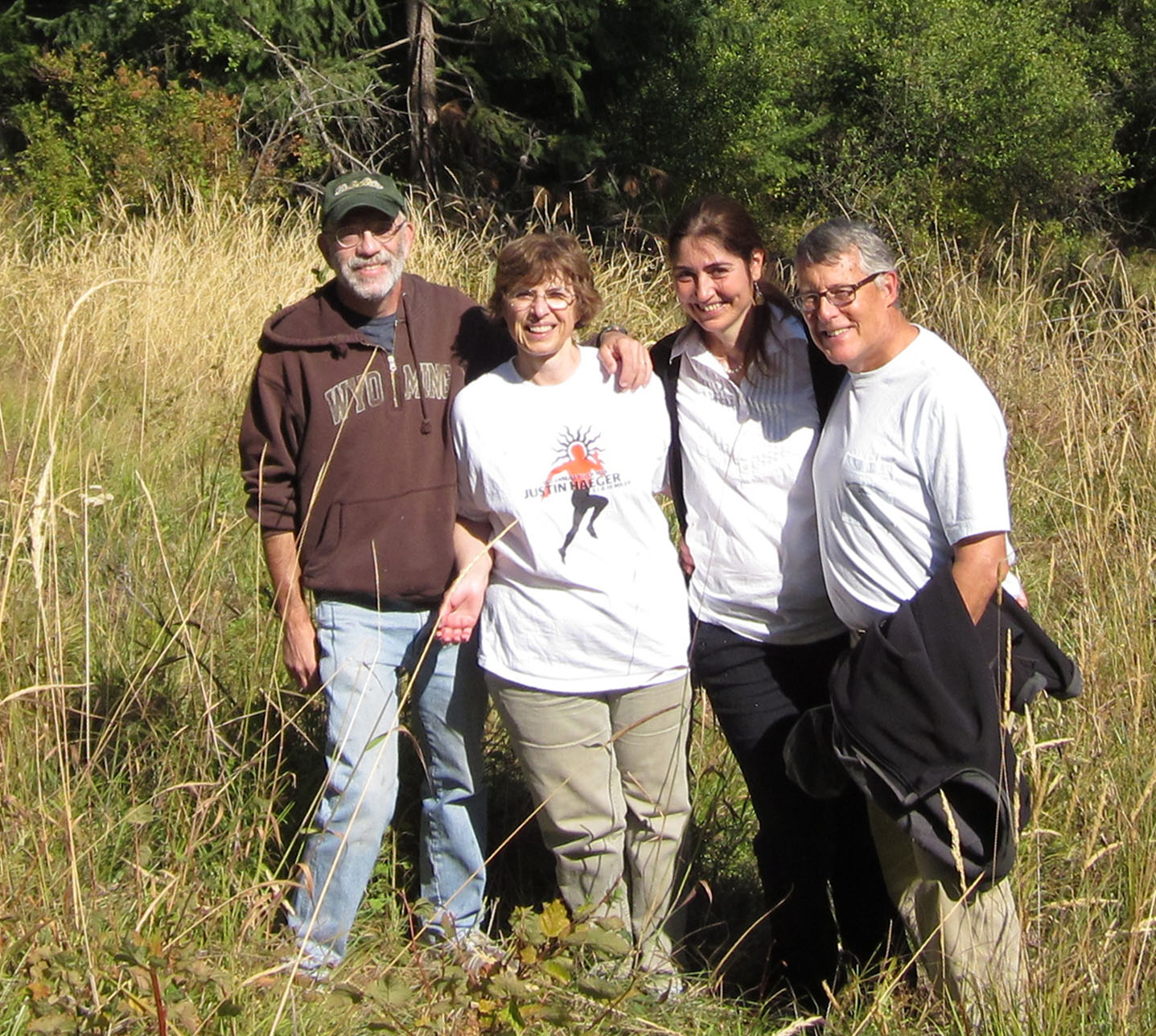
Karen and I loitered in the arrivals area of Spokane Airport, waiting for the plane to debark. The arrivals board showed the plane had arrived on time. A Chinese family reunited; a foreign exchange student smiled at a couple holding his name on a placard. Then, there they were. Steve had aged, as had we, bearing the signs of too much work and a broken neck suffered the year before; Luzma was tall and slim, with long dark hair and eyes so dark they seemed to be all pupil. Hugs all around and back to our house, catching up with Steve, learning about Luzma.

What a wonderful visit. We had breakfasts in and lunches out. I cooked standard American fare for dinner; Luzma made a delicious dish from Spain. We drank good beer (Red Hook ESB) and better wine Steve bought on a visit to Arbor Crest Winery. We took long walks on our land and had long talks by the creek. We visited Coeur d'Alene; I took Steve for a ride to the top of our property on my ATV; we picked blueberries at our neighbor's patch; Steve and Luzma taught us a card game, which we enjoyed with a neighboring couple.

Our friendship with Steve didn't miss a beat; and we felt we'd known Luzma for years rather than days. Old friends and new - three of us now in our 60s, one in her 50s. Soon, perhaps, a visit to Steve and Luzma in Virginia, or a week in Vancouver, or even a trip to Spain (at least one of us can speak Spanish - and it's not me).

Tuesday, August 23, 2011

Dragonfly Summer


The sky above our lower meadow resembled the Battle of Britain tonight, shapes soaring and darting through the skies, skimming the long yellowing grass, paths crossing, wings shimmering in the western light. It was the annual summer massacre of the dragonflies.

Yesterday evening, Kerry and I sat on the porch watching dozens of dragonflies hovering over the driveway, then flashing off. Occasionally - very occasionally - one of our cats would suddenly leap into the air, swiping with a quick paw. Our orange tabby, Ricky, trotted away with a dragonfly tail dangling from his soft mouth, awfully pleased with himself.

But tonight, it was slaughter in the fields, as dozens of swallows flew above the meadow chasing the low-flying insects, faster than the camera lens could follow. It lasted about 30 minutes, until the sun dropped lower in the sky, throwing the meadow into shadow. The swallows moved up the hill into the sunlight, hoping for a second course.


Right You Are, Guy!

Funny thing about Texas. It produces some
unbelievable politicians. And, it produces some
UNBELIEVABLE songwriters. Think Townes Van Zant, Nanci Griffith, Robert Earl Keen, or Guy Clark.

Back when we lived in Laramie, we went to see Keen and Clark in concert. One of Clark's most popular songs was Homegrown Tomatoes:

"Only two things that money can't buy
That's true love & homegrown tomatoes"

Well, I've got both. Later this month, Kerry and I celebrate our 31st wedding anniversary. And the four tomato plants in the back yard are really producing this summer. Last year, not so much. After a lot of care, filling the bottom of Home Depot buckets with gravel and mixing dried cow pies into the soil, they produced three tomatoes.

We took a different approach this year. No gravel, no manure. Just soil and water, with grass clippings to shade the soil and a sprinkle of Miracle Gro once a week. Tomato production is booming. Four Early Girls have already made their sweet, juicy way into salads and sandwiches, and the plants have dozens of fruits growing and more blossoms ready to produce.

If frost holds off - nights are in the 50s - we should be eating homegrown tomatoes well into fall. and that's gastronomic true love.

Tuesday, August 9, 2011

HERITAGE CHERRIES

Donovan stretching

We have a heritage yellow cherry tree on the place. It must be about 75 years old, for it was a good size when my parents and I moved up here in 1951. The cherries are deliciously sweet.  My parents, not being horticulturists with a bent toward pruning, allowed it to continue its upward yearning until many of its bearing branches were out of reach.  Currently, only half of the tree survives, the other half having split off years ago. It's ancient but rugged, despite an occasional branch dying off.  Toward the end of July it bore heavily and Jay, my son Donovan and I made an effort to harvest as many as we could reach from the old wooden picking ladder.  Donovan is the tallest and has a great reach, so he was tagged to harvest the higher hanging fruit.

As I said, this is a heritage cherry, which means it is fungible and begins to turn brown a day after being picked.  I thought  only one yellow cherry variety existed until a few years ago when I came into possession of a wonderful large tome titled The Cherries of New York, by U.P. Hedrick, published in 1915, with beautiful color plates.  Being a dealer of rare books at the time and living far away from this particular old tree, I perused it and then sold it for a good price to a horticulturist in Australia. 

Now I wish I knew the cherry's variety and history.  Alas, The Cherries of New York is not a book one finds in the public library.  But wait.  Google has scanned books published before 1923 from major university libraries for our free download and use.  I do a lot of research on that site.  And sure enough, there is The Cherries of New York. None of  the color plates is of a white or yellow cherry, but of numerous long-forgotten black, red and orange varieties.  Toward the back of the book are short paragraphs on lesser-known varieties.  And here I find the white and yellow cherries.  So, is this tree a White French Guigne (1851),  whose flesh is creamy-white,  tender, melting, sweet; ripens in middle of July [in New York State]; or perhaps Fraser's White Tartarian (1803), pale yellow, approaching amber on the exposed cheek, with flesh juicy, pleasant, brisk subacid becoming sweet.  Or the White Transparent (1831), The White Spanish (1790), The White Mazzard (1838), The White Hungarian (1831), or The White French (1881).  Cherry varieties enough to make one dizzy. Or maybe it's the Yellow Glass (1903), introduced from North Silesia by Professor Budd of Ames, Iowa, its skin light lemon in color with firm yellow flesh, meaty, sweet, with colorless juice, and of good quality.  That fits it well.  But we'll never really know.

So, we ate some and dried the rest in our dehydrator for future use.  Chewy, sweet with just a hint of tartness.  And very brown and wrinkled.

Monday, July 25, 2011

THEY'RE BACK!

They're back!  And they've brought their chicks with them.

The wild turkeys (Meleagris gallopavo) that live in our valley move to higher ground for nesting and hatching their young, so from about April through most of July we don't see very many down here near the creek bottom.  One would think we'd be excited to have them back, but they are so ubiquitous that we've counted as many a one hundred in the pasture behind the house.  "And they leave tar-like shit in the driveway and on the porch," said Jay.

I'm not so sure that this area supported the wild turkey before the white man.  They certainly didn't live here when I was a kid in the 1950s.  It's the "trap and transfer" project about 12 years ago that dropped them into this valley.  It might be Merriam's Wild Turkey (M. g. merriami) that live here now, having originally thrived in the Rocky Mountain region, and having a predilection for roosting in ponderosa pines.  My mother found them delightful and fed them during the winters.  I've been told that she'd stand in the driveway surrounded by dozens of wild turkeys and whitetail deer, tossing out handfuls of cracked corn.  She always had an affinity for wild creatures.

But now their population has exploded.  Their predators are coyotes, bobcats, cougars, golden eagles, as well as  great horned owls, dogs and foxes.  Humans are actually the leading predator of wild turkeys.  I shouldn't complain about their numbers because we have been asked by hunters to open our land for turkey hunts, but have declined.  They do feel safe here - and if Mom were dead, instead of in assisted living with dementia, she'd roll over in her grave at the thought of hunting on her land.