Saturday, October 20, 2012

Night and the Cat


Geordie is a mature cat now, about seven and a half years old. It has been interesting, observing him gain hunting prowess through the years. Success in hunting did not come naturally to him. He had to work at it. Now he is at the pinnacle of his instinctive powers.  And he eats all that he kills.  Lately, Geordie has insisted on going out at twilight and not coming back until morning. I always thought this was "the dangerous time" because of coyotes; but when three of our cats were killed by a coyote in May, it was always in the late morning while they were hunting in the pasture. So, I let Geordie have his way. Maybe it is safer to hunt at night and sleep all day.

This overwhelming desire of his reminded me of a poem by Elizabeth Coatsworth, published in 1950 in a rather rare little book titled Night and the Cat.  I collect children's cat books and, fortunately, picked this up at a library sale for fifty cents. The poem is

                                                   On a Night of Snow

Cat, if you go outdoors, you must walk in the snow.
You will come back with little white shoes on your feet,
little white shoes of snow that have heels of sleet.
Stay by the fire, my Cat.  Lie still, do not go.
See how the flames are leaping and hissing low.
I will bring you a saucer of milk like a marguerite,
so white and so smooth, so spherical and so sweet --
stay with me, Cat.  Outdoors the wild winds blow.

Outdoors the wild winds blow, Mistress, and dark is the night,
strange voices cry in the trees, intoning strange lore,
and more than cats move, lit by our eyes' green light,
on silent feet where the meadow grasses hang hoar --
Mistress, there are portents abroad of magic and might,
and things that are yet to be done.  Open the door!

Artist: Lionel Lindsay

Friday, October 19, 2012

1920 - Women Get the Vote


My grandparents married in 1910.  American women were given universal suffrage by the passage of the 19th Amendment shortly before the national election in 1920.  My grandfather wouldn't allow my grandmother to vote . . . until . . . in 1936, he was afraid Franklin D. Roosevelt wouldn't be reelected.  He made sure Grandma voted that year.  It was a heady experience for her and she never allowed him to keep her from voting again.  She took her right to vote seriously.


So did a lot of women who had fought for that right, decade after decade. . . state by state.


Women's suffrage laws before passage of the Nineteenth Amendment
  Full suffrage
  Presidential suffrage
  Primary suffrage
  Municipal suffrage
  School, bond, or tax suffrage
  Municipal suffrage in some cities
  Primary suffrage in some cities
  No suffrage


Why did the western states give women equal suffrage before the rest of the country?  Wyoming women began voting while it was still a territory in 1869.  And the territorial legislature put women's suffrage into its new state constitution (after much lobbying by women).  When the U.S. Congress, strongly opposed to women's suffrage, threatened to withhold statehood from Wyoming, Cheyenne officials sent back a a staunchly worded telegram stating that Wyoming would remain out of the Union 100 years rather than join without women's suffrage.  On July 10, 1890, President Benjamin Harrison signed the bill approving Wyoming as the nation's "Equality State."

 In 1893, voters of Colorado made that state the second of the woman suffrage states and the first state where the men voted to give women the right to vote. In 1896 Idaho approved a constitutional amendment in a statewide vote giving women the right to vote.

Apparently, a majority of western men, who shared pioneering hardships with women, viewed them as equals.

California women's suffrage campaign poster

Iowa women's suffrage campaign poster.


Today we might wonder, "What was the big fuss about? Why would men east of the Mississippi and in the South keep women from voting?"


Because men in power do not share that power easily.  Any change is a threat to the status quo which gives men comfort.


Men used ridicule. . . 


arrest and imprisonment . . . and painful forced feeding when their female prisoners went on hunger strikes . . . which some men found humorous.

On January 12, 1915, a suffrage bill was brought before the House of Representatives, but was defeated by a vote of 204 to 174. President Wilson opposed women's suffrage. And then World War I came along, bringing social change with it.  Another bill was brought before the House on January 10, 1918. On the evening before, President Wilson, who had been pressured to change his mind, made a strong and widely published appeal to the House to pass the bill. It was passed by two-thirds of the House, with only one vote to spare. The vote was then carried into the Senate. Again President Wilson made an appeal, but on September 30, 1918, the amendment fell two votes short of passage. On February 10, 1919, it was again voted upon, and then it was lost by only one vote.
There was considerable anxiety among politicians of both parties to have the amendment passed and made effective before the general elections of 1920, so the President called a special session of Congress, and a bill, introducing the amendment, was brought before the House again. On May 21, 1919, it was passed, 42 votes more than necessary being obtained. On June 4, 1919, it was brought before the Senate, and after a long discussion it was passed, with 56 ayes and 25 nays. Within a few days, Illinois, Wisconsin and Michigan ratified the amendment, their legislatures being then in session. Other states followed suit at a regular pace, until the amendment had been ratified by 35 of the necessary 36 state legislatures. After Washington State on March 22, 1920, ratification languished for months. Finally, on August 18, 1920, Tennessee narrowly ratified the Nineteenth Amendment, making it the law throughout the United States. The deciding vote in the Tennessee legislature was cast by a state legislator, who had voted against it earlier, but on this day had 

received a note from his mother, imploring him to "be a good boy" and vote for ratification.  

He did.


American women fighting for equal suffrage endured hostility, humiliation, assault and battery to gain your right to vote, ladies.  Please exercise your full citizenship by voting on November 6th.

Monday, October 15, 2012

And Jay Gets a Kitchen of His Own


During the past three and a half years Jay and I lived in my childhood home that Mom and Dad built in the 1950s.  When I said, "This is Mom's kitchen and I can't do anything here," Jay took me literally and did all of the cooking and dish washing by hand.  He likes to cook, but he yearned for a dishwasher.

He put a lot of thought into the design of his kitchen.  A lighter granite on the counters called Kashmir Gold,
and a black granite called Gold Spectrus on the island with striations of blues and colors that have no names.


He wanted a cooktop and a wall oven, which intrigued me because we've always had "just" a stove. Note the apple pie fresh from the oven.


Jay makes great sugar-free apple pies using apples from our trees.


Lots of cabinet space, including a pantry cabinet with double doors . . . .


. . . and inside sections that swivel out to reveal even more shelf space behind.  He even had an electric socket wired bottom right in case he decides to install a small wine cooler.  Right now I have the dust buster plugged in there.


Lots of cabinet space under his cooktop, including  a pull-out spice cabinet..  Actually, that was my suggestion.


Room for two stools and the large water dispenser for Pepper, the Brittany. Electric sockets under the granite around the island, so we can sit on our stools, drink tea, and work on our laptops . . . or plug in other  implements such as the dehydrator for apples and plums. The three hanging lanterns are actually more golden  when they're on than appears in the photo.


Shelving for our Van Briggle pottery and Batchelder tile collections.


And even a high spot for Jay's gargoyle that he brought back from Paris when he was fourteen.

Sunday, October 14, 2012

When Ladies Painted China


People who bring to The Antiques Roadshow hand-painted china that their great-grandmothers decorated in the latter part of the 19th or early years of the 20th century are told that the only value is for decoration, and that at one time nearly every middle class and upper class household had a lady who painted china.

It's a lovely part of America's social history.  There was a journal that assisted the ladies with design, encouraged ceramics clubs, and even printed photos of successful outcomes.  Keramic Studio.


My small collection of signed hand-painted china from the Arts and Crafts period of American design has just been unboxed from five years in a storage unit. I'm delighted to have these pieces back on the shelves So here is a photo essay.


One of a set of four bouillon soup bowls - about the size of a teacup., simple and elegant.

I think I've found the pattern for this signed plate (one of six Jay found for me somewhere in Wyoming) in a Keramic Studio for 1908.


My neighbor Mary in Laramie found this signed cereal bowl and pitcher in Kentucky -- my reward for watering her flowers while she was visiting her daughter.


Most of the china blanks came from France and Germany before World War I.  Then Nippon (Japan) during the war. 


The poppy was a favorite design.


Stylized poppy . . .


Or not . . . another gift from Mary for watering her garden. 


My other dear friend in Laramie, Sue, gave me this hand-painted plate in the Art Nouveau style.


The dragonfly was another popular subject. I think this is a serving dish for bon bons.

 A large charger intended to be hung on a wall. The peacock feather was also popular -

With many stylizations to choose from.

This pattern was submitted to Keramic Studio and won first prize in design.


And this pattern is similar.


A rather large bread tray with gold chrysanthemums. Gold outlining and design was popular during this period.


A candy dish.


A pin tray more of the 1920s Art Deco period.


As is this squash blossom design, signed and dated 1923.  A touch of the southwest. And the decorator has a Hispanic last name.


A set of 6 of this sherbet dishe came from Austria and almost seem more Vienna Secession than American Arts and Crafts.

A trivet for hot teapots.


A candlestick.


A simple design of a cup and saucer from a set I'm sure the decorator really intended to use.


And waterlilies were popular, too. 

Thursday, October 11, 2012

A Little Journey Around a Room of My Own


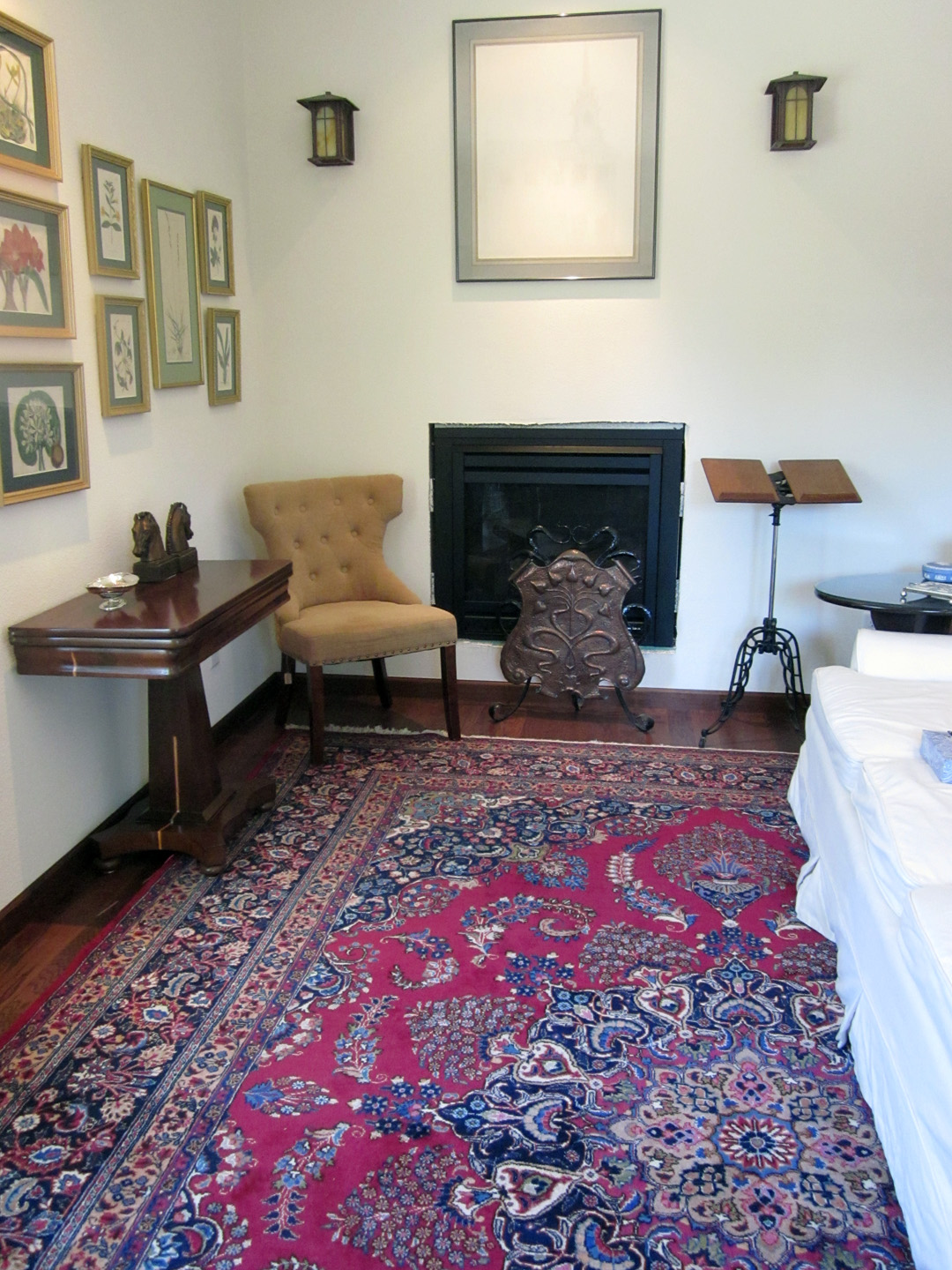
Come into my new study.  When Virginia Woolf said a woman needs "a room of own's own," I took her literary -- well, not at the time -- she wrote about it around 1928. Within my little room are many of my cherished items . . . and . . . I didn't have to compromise with my dear husband in its decoration. Jay commented, "You've stuffed as much as you can in here."  Yes, I have.

My friend Jen said in her blog that a  little black vase  makes flowers look their best, and illustrated it with lovely examples.  So, I found a black vase at a charity shop for $1.00 (I love charity shops).  And Jen is so right.  Then I thought, "What if I put more of my black items in the same area?"


The curio shelf in the middle was crafted by my grandfather in the 1950s after he retired from the Northern Pacific Railroad. Mom had painted it pale blue.  I spray painted it black lacquer. To the right is my son Donovan's first grade Christmas gift to me. 


And to the left is a set of silhouettes from a damaged old children's book I salvaged, matted and framed.  They never found a place in our last house, but I like them here. 


When I was eighteen, I toured Europe with a group of students, sponsored by People to People.  I bought this Russian lacquer box in Budapest.  Most of the boxes were of fairy tales and troikas, but this had the theme, as I interpreted it, of "progress through communism.:  There's the hammer and sickle, the red star, and a rocket going into space.  Intriguing, yes?


This room isn't finished yet.  I have to decide on a fireplace surround and shelving to the right.  We had to have the room expanded so it would accommodate our Sabsevar Persian rug. 


The art over the fireplace is a pencil study by the American artist, Lilian Westcott Hale. It's difficult to photograph (reflection) and I've had to darken it so you can see it.  When Jay first drew my attention to it at an auction in Washington, D.C., I looked up and saw only a framed blank. A trick of the eye and brain. Gradually, the image formed. I've loved it ever since.

  
This is my classical corner with hand-painted 18th and early 19th century botanicals and an antique mahogany game table. I have a friend, Cheryl, a Scrabble whiz. We plan on playing Scrabble here while the men watch football in the family room.


I told the cats that they can come into my study only if they refrain from clawing the rug and furniture.  This wingback had to be recovered.  Geordie has been good so far.


 Within this circa 1830 mahogany armoire, made in Perth, Scotland (there's an old label on the back), I keep my CDs and components. Jay has hidden the speakers up behind the crown.


Another Christmas gift from my son, Donovan, when he was small.


We found this little antique footstool in Yorkshire. The British call inlaid wood items treen.

Augustus Saint-Gaudens designed the memorial Grief (1891) for Clover Adams, wife of Henry Adams.  She committed suicide by drinking developing fluid. It sits in Rock Creek Cemetery in Washington, D.C. I had to wait a long time for the light to be right.  Nothing better than having your own study for your own photos.


This carnival glass vase was made in Fredonia, Kansas, circa 1906-10.  My great-grandmother boarded men who worked in the glass factory and one gave her this vase he made. Probably his foreman rejected it, but the family has always cherished it, and when sunlight hits it . . . just lovely.


Ah, well, I don't want to bore you with more of my "treasures."  As we leave, though, I will point out this paper fan that was handed out at Oberlin College's graduation (I bet it was held outside), circa 1900 - 1910, that I found in an antiques mall years ago. Very Art Nouveau.